Showing posts with label dinosaurs. Show all posts

Stegosaurs in GURPS

A clade of herbivorous dinosaurs, known for their spinal plates, spiked tails, and tiny brains. Their heads were small and elongated, with beaks at the front and small chewing teeth inside fleshy cheeks. The shoulder girdle was very robust, with many species having horn-like spikes projecting from their shoulders. The torso widened and raised vertically from the shoulders to the hips, with the hind legs being significantly larger than the front ones. Their tails were held straight out, parallel to the ground, but were flexible in the horizontal plane, allowing them to swing the spiked tips (“thagomizers”) in a deadly arc.

The first known family of stegosaurians were the Huayangosauridae of middle Jurassic East Asia (eastern Laurasia at the time), such as Huayangosaurus and Bashanosaurus. These were the only members of the clade which seemed capable of running. They had small plates running in symmetrical rows down either side of their spines and long shoulder spikes. Their last, and largest, known member was Gigantspinosaurus, which lived in the late Jurassic and had huge shoulder spikes.

The larger Stegosaurids had diverged from the Huayangosauridae by the middle Jurassic, with Tuojiangosaurus being an early example. Its spinal plates were longer and more triangular than those of Huayangosaurids, and it had less flexible legs to support its greater weight. Another branch of Stegosaurids formed the Neostegosauria, which comprised two families: the Dacentrurinae and Stegosaurinae.

The Dacentrurinae had a wide distribution and were distinguished by the transformation of their rear spinal plates into spikes, and long necks. Adratiklit and Thyreosaurus lived in middle Jurassic North Africa (northern Gondwana), while the late Jurassic had Kentrosaurus in East Africa (central Gondwana), Dacentrurus in Europe (central Laurasia), and Miragaia in North America (western Laurasia).

Stegosaurines had broad, staggered spinal plates. In Yingshanosaurus, from middle Jurassic East Asia, these were fairly small and shoulder spikes were still present. Later members of the family had larger plates and no shoulder spikes. In East Asia these included the late Jurassic Jiangjunosaurus and early Cretaceous Wuerhosaurus. Late Jurassic North America had Hesperosaurus, and the famous Stegosaurus, which included the well-known S. stenops and the larger S. ungulatus.

Huayangosaurus

ST 21; DX 10; IQ 2; HT 12.
HP 21; Will 10; Per 10; FP 12; Speed 5.50; Dodge 8; Move 5.
SM +3 (3 hexes), 1,100 lbs.

Shoulder spike (10): 2d impaling. Reach 1. Limited arc, sides.
Thagomizer (10): 2d+2 impaling. Reach 2. Limited arc, rear.
Trample (10): 2d / 1d−2 crushing. See GURPS Basic Set, p. 404.

Traits: Bad Sight (Low Resolution); DR 3 (Tough Skin); Enhanced Move 1 (Ground Speed 10; Costs Fatigue, 1 FP/second); Night Vision 1; Peripheral Vision; Quadruped; Wild Animal.
Skills: Survival (Woodlands)-10.

Use the same profile for Bashanosaurus.

For Gigantspinosaurus (1,500 lbs.) increase ST and HP to 23, and shoulder spike Reach to 2. Damage increases to 2d+3 with a shoulder spike or thagomizer, 2d+1 / 1d−1 with a trample.

Tuojiangosaurus

ST 38; DX 9; IQ 2; HT 12.
HP 38; Will 10; Per 10; FP 12; Speed 4.00; Dodge 7; Move 5.
SM +4 (4 hexes), 7,000 lbs.

Shoulder spike (9): 4d impaling. Reach 1. Limited arc, sides.
Thagomizer (9): 4d+4 impaling. Reach 3. Limited arc, rear.
Trample (9): 4d / 2d−1 crushing. See GURPS Basic Set, p. 404.

Traits: Bad Sight (Low Resolution); DR 6 (Tough Skin); Night Vision 1; Peripheral Vision; Quadruped; Wild Animal.
Skills: Survival (Plains)-10.

For Yingshanosaurus (3,000 lbs.) reduce ST and HP to 29, SM to +3 (3 hexes), DR to 4, and thagomizer Reach to 2. Damage drops to 3d with the shoulder spikes, 3d+3 with the thagomizer, 3d / 1d with a trample.

Dacentrurus

ST 47; DX 9; IQ 2; HT 12.
HP 47; Will 10; Per 10; FP 12; Speed 4.00; Dodge 7; Move 5.
SM +4 (5 hexes), 13,000 lbs.

Long Spines (5): 1d impaling. Reach C. Attack as a free action. See GURPS Basic Set, p. 88.
Thagomizer (9): 5d+6 impaling. Reach 4. Limited arc, rear.
Trample (9): 5d+1 / 2d+1 crushing. See GURPS Basic Set, p. 404.

Traits: Bad Sight (Low Resolution); DR 7 (Tough Skin); Long Neck 1*; Night Vision 1; Peripheral Vision; Quadruped; Wild Animal.
Skills: Survival (Plains)-10.

* see GURPS Furries, p. 12.

For Adratiklit (8,800 lbs.) reduce ST and HP to 41, and DR to 6. Damage drops to 4d+6 with the thagomizer, 4d+2 / 2d−1 with a trample. Change Survival specialty to (Swampland).

For Thyreosaurus (7,000 lbs.) reduce ST and HP to 38, and DR to 6. Damage drops to 4d+4 with the thagomizer, 4d / 2d−1 with a trample. Change Survival specialty to (Woodlands).

For Kentrosaurus (2,500 lbs.) reduce ST and HP to 27, SM to +3 (3 hexes), and DR to 4. Damage drops to 3d+2 with the thagomizer, 3d−1 / 1d with a trample.

For Miragaia (3,300 lbs.) reduce ST and HP to 30, and DR to 5. Damage drops to 3d+3 with the thagomizer, 3d / 1d+1 with a trample.

Stegosaurus stenops

ST 39; DX 9; IQ 2; HT 12.
HP 39; Will 10; Per 10; FP 12; Speed 4.00; Dodge 7; Move 5.
SM +4 (4 hexes), 7,700 lbs.

Thagomizer (9): 4d+5 impaling. Reach 3. Limited arc, rear.
Trample (9): 4d+1 / 2d−1 crushing. See GURPS Basic Set, p. 404.

Traits: Bad Sight (Low Resolution); DR 6 (Tough Skin); Night Vision 1; Peripheral Vision; Quadruped; Wild Animal.
Skills: Survival (Plains)-10.

For S. ungulatus or Wuerhosaurus (9,000-9,300 lbs.) increase ST and HP to 42, DR to 7, and thagomizer Reach to 4. Damage increases to 4d+6 with the thagomizer, 4d+2 / 2d with a trample.

For Jiangjunosaurus (5,500 lbs.) reduce ST and HP to 35, and DR to 5. Damage drops to 4d+3 with the thagomizer, 4d−1 / 1d+2 with a trample.

For Hesperosaurus (7,700 lbs.) change Survival specialty to (Woodlands).

Megalosaurs in GURPS

A group of large theropod carnivores, closely related to the spinosaurs. They emerged during the early Jurassic, diversified in the middle Jurassic, and died off around the start of the Cretaceous. They had large heads, slender bodies, and long tails. Their arms had three claws, while their feet had four, although one of the latter was a small dewclaw. Unlike many of their relatives, their faces usually lacked horns or ridges. Their size combined with the warm Jurassic climate suggests that they would have little need for insulation as adults, and they have traditionally been portrayed with bare, scaly skin, but simple hair‐like proto‐feathers are also plausible, especially for juveniles.

Megalosaurus bucklandii was a fairly typical member of the family which lived in central Laurasia (in what is now Britain) during the middle Jurassic. It was the first dinosaur to be given a binomial scientific name. Poekilopleuron bucklandii may be a closely related genus, another species of Megalosaurus, or a somewhat larger individual of the same species. Duriavenator and the larger Wiehenvenator were also closely related and come from around the same time and place. Torvosaurus was another close relative, from later in the Jurassic and further west (in what is now the United States), which reached a similar size to Wiehenvenator

The relationships between other megalosaurids are less clear. Eustreptospondylus lived close to Megalosaurus around the same time, but was only distantly related. Afrovenator was a large predator which lived in the jungles of northern Gondwana (now Niger) from the middle to late Jurassic. It seems to have been closely related to Dubreuillosaurus and Magnosaurus which lived in Laurasia (now France and Britain, respectively) during the middle Jurassic. The huge Piveteausaurus from central Laurasia (now France) during the late Jurassic may be related to the smaller Leshansaurus from eastern Laurasia (now China) during the middle Jurassic, but it isn't clear if they are even megalosaurids.

Megalosaurus

ST 23; DX 11; IQ 3; HT 11.
HP 23; Will 10; Per 12; FP 11; Speed 5.50; Dodge 8; Move 5.
SM +2 (3 hexes), 1,600 lbs.

Bite (13): 2d+2 cutting. Reach C.
Fore‐claw (13): 1d−1 cutting. Reach C.
Kick (11): 2d+3 cutting. Reach C.
Tail (11): 2d+3 crushing. Reach 1–3. Limited arc (rear).

Traits: Born Biter 2; Discriminatory Smell; DR 2 (Tough Skin); Enhanced Move 1 (Ground Speed 10; Costs Fatigue, 1 FP/Second); Night Vision 1; No Fine Manipulators; Weak Arms 2 (½ ST); Wild Animal.
Skills: Brawling–13; Stealth–11; Survival (Island/Beach)–12; Swimming–12.

For Poekilopleuron or Duriavenator(2,200 lbs.) increase ST and HP to 26, SM to +3 (4 hexes), and damage to 2d+3 with a bite, 1d with fore‐claw, and 2d+4 with kick or tail.

For Wiehenvenator (4,400 lbs.) increase ST and HP to 33, SM to +3 (5 hexes), DR to 3, damage to 3d+4 with a bite, 1d+2 with fore‐claw, and 3d+5 with kick or tail, and tail reach to 1–4.

For Torvosaurus (4,400 lbs.) increase ST and HP to 33, SM to +3 (5 hexes), DR to 3, damage to 3d+4 with a bite, 1d+2 with fore‐claw, and 3d+5 with kick or tail, and tail reach to 1–4. Change Survival specialty to (Plains).

For Eustreptospondylus (1,100 lbs.) reduce ST and HP to 21, and damage to 2d+1 with a bite, 1d−1 with fore‐claw, and 2d+2 with kick or tail.

For Afrovenator (3,300 lbs.) increase ST and HP to 30, SM to +3 (4 hexes), DR to 3, and damage to 2d+3 with a bite, 1d+1 with fore‐claw, and 2d+4 with kick or tail. Change Survival specialty to (Jungle).

For Dubreuillosaurus (750 lbs.) reduce ST and HP to 18, DR to 1, and damage to 1d+2 with a bite, 1d−2 with fore‐claw, and 1d+3 with kick or tail. Change Survival specialty to (Swampland).

For Magnosaurus (500 lbs.) reduce ST and HP to 16, DR to 1, and damage to 1d+1 with a bite, 1d−3 with fore‐claw, and 1d+2 with kick or tail.

For Piveteausaurus (8,000 lbs.) increase ST and HP to 40, SM to +4 (6 hexes), DR to 4, damage to 4d+4 with a bite, 2d−1 with fore‐claw, and 4d+5 with kick or tail, and tail reach to 1–5.

For Leshansaurus (1,600 lbs.) change Survival specialty to (Woodlands).
Alternative Interpretations

Megalosaurus fossils were first understood as the remains of elephants or giants. When some reptilian features were recognized, it was described as a huge, amphibious, lizard‐like quadruped, 40 feet long, 8 feet at the shoulder, and weighing as much as an elephant. Later estimates gave sizes from 30 up to 70 feet in length. A sculpture by Benjamin Waterhouse Hawkins based on this description can be found among the Crystal Park Dinosaurs.

Megalosaurus (Quadrupedal Reptile)

ST 43; DX 8; IQ 2; HT 12.
HP 43; Will 10; Per 10; FP 12; Speed 5.00; Dodge 8; Move 5.
SM +5 (21 hexes), 10,000 lbs.

Bite or Claw (10): 5d+3 cutting. Reach C.
Tail (8): 5d+4 crushing. Reach 1–4 Limited arc (rear).

Traits: Amphibious; Bad Sight (Low Resolution); Born Biter 1; Cold‐Blooded (65°F); Discriminatory Smell; DR 4 (Tough Skin); Night Vision 1; Quadruped; Wild Animal.
Skills: Brawling–10; Survival (Island/Beach)–12; Swimming–15.

This represents the 40 foot version. For a 70 foot colossus (26 tons), increase ST and HP to 75, SM to +7 (36 hexes), DR to 7, damage to 8d+9 with a bite or claw and 8d+10 with the tail, and tail reach to 1–7. A 30 foot beast (2 tons) would have ST and HP 32, SM +4, DR 3, do 3d+3 damage with a bite or claw, and 3d+4 with its tail, which would have a reach of 1–3.

Eudromaeosaurs in GURPS

A group of bipedal carnivores, famed for the scythe-like talons on the second toe of each foot. Their short S-shaped necks were flexible to allow precision bites, while their long, stiff tails provided balance. Evidence suggests that they were fully feathered, including long feathers on the arms. While not capable of true flight, they may have used their wing-like arms for stabilisation while subduing prey or to control jumps. Although they had hands, their fingers were not well suited to manipulating objects.

Dromaeosaurinae

This group had broad, powerful jaws and reached the largest body sizes among the family. There is some evidence that they hunted in packs.

Deinonychus and Utahraptor lived in Laramidia, now western North America, during the early Cretaceous. Dakotaraptor and Dromaeosaurus occupied the same landmass in the late Cretaceous, while Achillobator was found in East Asia.

Deinonychus

ST 11; DX 13; IQ 4; HT 11.
HP 11; Will 11; Per 12; FP 11; Speed 6.00; Dodge 10; Move 6.
SM +2 (3 hexes), 150 lbs.

Bite (15): 1d cutting. Reach C.
Kick (15): 1d impaling. Reach C, 1.

Traits: Born Biter 1; Discriminatory Smell; DR 1 (Flexible); Catfall; Combat Reflexes; Enhanced Move 1 (Ground Speed 12; Costs Fatigue, 1 FP/Second); Ham-Fisted 2; Striking ST 2 (Bite Only); Night Vision 1; Wild Animal.
Skills: Brawling-15; Stealth-13; Survival (Woodlands)-12; Wrestling-14.
Techniques: Kicking-15.

Utahraptor (900 lbs.) increases ST and HP to 19 (damage 2d+1 with bite or kick), Move to 5 (Ground Speed 10 with Enhanced Move), and SM to +3 (5 hexes). Kick reach becomes C-2.

Dakotaraptor (700 lbs.) increases ST and HP to 18 (damage 2d with bite, 1d+3 with kick) and SM to +3 (5 hexes). Kick reach becomes C-2.

Dromaeosaurus (30 lbs.) reduces ST and HP to 6, SM to 0 (2 hexes), and Striking ST to 1 (damage 1d−3 with bite or kick).

Achillobator (550 lbs.) increases ST and HP to 16 (damage 1d+2 with bite or kick) and SM to +3 (4 hexes). Kick reach becomes C-2.

Saurornitholestinae

A group of small dinosaurs with relatively deep, short snouts and long arms. They lived in Laramidia during the late Cretaceous. Their limbs seem well suited to climbing and they may have had some ability to glide short distances.

Saurornitholestes

ST 6; DX 14; IQ 4; HT 10.
HP 6; Will 11; Per 12; FP 10; Speed 6.00; Dodge 10; Move 6.
SM −1, 30 lbs.

Bite (16): 1d−4 cutting. Reach C.
Kick (16): 1d−3 impaling. Reach C.

Traits: Born Biter 1; Discriminatory Smell; Combat Reflexes; Enhanced Move 1 (Ground Speed 12; Costs Fatigue, 1 FP/Second); Flight (Gliding; Winged); Ham-Fisted 2; Night Vision 1; Wild Animal.
Skills: Brawling-16; Climbing-16; Survival (Woodlands)-12.
Techniques: Kicking-16.

This profile is also suitable for Atrociraptor.

Bambiraptor (15 lbs.) reduces ST and HP to 5.

Velociraptorinae

Fast, dog-sized predators from East and Central Asia during the late Cretaceous. They had narrow snouts and long legs. There is no evidence of them pack hunting, and they seem to have specialised in smaller prey.

Velociraptor

ST 8; DX 13; IQ 4; HT 11.
HP 8; Will 11; Per 12; FP 11; Speed 6.00; Dodge 10; Move 7.
SM 0 (2 hexes), 60 lbs.

Bite (15): 1d−3 cutting. Reach C.
Kick (15): 1d−2 impaling. Reach C.

Traits: Born Biter 1; Discriminatory Smell; Combat Reflexes; Enhanced Move 1 (Ground Speed 14; Costs Fatigue, 1 FP/Second); Ham-Fisted 2; Night Vision 2; Super Jump 1; Wild Animal.
Skills: Brawling-15; Jumping-15; Survival (Desert)-13.
Techniques: Kicking-15.

This profile is also suitable for related genera like Kansaignathus and Linheraptor.

Hadrosaurine Dinosaurs in GURPS

The ‘duck-billed’ dinosaurs had wide, flat beaks, and numerous small teeth. Their bodies were narrow and deep, and their tails straight and tapered, giving them a ‘teardrop’ outline. They usually walked on four legs, but could rise to a bipedal stance.

They seem to have lived in herds and engaged in extensive parental care. All date to the late Cretaceous.

Brachylophosaurini

This tribe inhabited the forests of Laramidia, now the west of North America. They ate a wide variety of vegetation including tough material like rotting wood. They were highly social, with herds of thousands of individuals of all ages.

The history of the genus shows a trend towards increasing size and development of a small horizontal crest across the upper skull. Acristavus had no crest, Probrachylophosaurus had a very modest one, and Brachylophosaurus had the most developed form, extending past the back of the skull. Maiasaura appears to have been an off-shoot and had small spikes above each eye. These crests may have been for display or used in pushing contests.

Brachylophosaurus

ST 44; DX 9; IQ 3; HT 11.
HP 44; Will 10; Per 10; FP 11; Speed 5.00; Dodge 8; Move 4.
SM +5 (6 hexes), 15,000 lbs.

Head-Shove (11): 5d+3 crushing. No wounding, double knockback. Reach C.
Trample (11): 5d+4 crushing.

Traits: Bad Sight (Low Resolution); Discriminatory Smell; DR 2 (Tough Skin); Enhanced Move 1 (Ground Speed 8; Costs Fatigue, 1 FP/Second); Gregarious; No Fine Manipulators; Peripheral Vision; Semi-Upright; Weak Bite; Wild Animal.
Skills: Brawling-11; Survival (Woodlands)-12.
Techniques: Head-Shove (Brawling)-11.

Acristavus (6,600 lbs.) reduces ST and HP to 38 (damage 4d+3 with head-shove, 4d+4 with trample) and SM to +4 (4 hexes).

Probrachylophosaures (11,000 lbs.) reduces ST and HP to 44 (damage 5d+3 with head-shove, 5d+4 with trample).

Maiasaura (5,500 lbs.) reduces ST and HP to 35 (damage 4d+2 with head-shove, 4d+3 with trample) and SM to +4 (4 hexes).

New Technique: Head-Shove

Hard
Default: Brawling−2.
Prerequisite: Brawling, cannot exceed prerequisite skill.
You push your opponent away using your head. Treat this as a head-butt which inflicts no injury, but doubles its damage for purposes of knockback.

Edmontosaurini

Edmontosaurus lived in northern Laramidia. E. regalis had a fleshy display crest on its head, while E. annectens was unadorned. Both had paddle-shaped bills.

Related genera from East Asia include Kamuysaurus, Kerberosaurus, Kundurosaurus, and the gigantic Shantungosaurus.

Edmontosaurus regalis

ST 41; DX 10; IQ 3; HT 11.
HP 41; Will 10; Per 10; FP 11; Speed 5.00; Dodge 8; Move 4.
SM +4 (5 hexes), 8,500 lbs.

Claw (10): 4d+5 crushing. Reach C-2.
Trample (10): 4d+2 crushing.

Traits: Bad Sight (Low Resolution); Chummy; Discriminatory Smell; DR 2 (Tough Skin); Enhanced Move 2 (Ground Speed 16; Costs Fatigue, 1 FP/Second); No Fine Manipulators; Peripheral Vision; Semi-Upright; Weak Bite; Wild Animal.
Skills: Survival (Woodlands)-12.

Edmontosaurus annectens (13,000 lbs.) increases ST and HP to 47 (damage 5d+5 with claw, 5d+1 with trample) and SM to +5 (7 hexes).

Kamuysaurus, Kerberosaurus, and Kundurosaurus (5,000 lbs.) reduce ST and HP to 34 (damage 3d+4 with claw, 3d+2 with trample).

Shantungosaurus (30,000 lbs.) increases ST and HP to 62 (damage 5d+5 with claw, 5d+1 with trample), SM to +6 (25 hexes), and DR to 3.

Hadrosaurus

Known only from a single partial skeleton, Hadrosaurus seems to have been a fairly ‘primitive’ hadrosaurine with a relatively robust build. It lived in Appalachia, now the eastern US.

Hadrosaurus

ST 33; DX 10; IQ 3; HT 12.
HP 33; Will 10; Per 10; FP 12; Speed 5.00; Dodge 8; Move 5.
SM +4 (4 hexes), 2,200 lbs.

Kick (8): 3d+5 crushing. Reach C-2.
Trample (10): 3d+2 crushing.

Traits: Bad Sight (Low Resolution); Chummy; Discriminatory Smell; DR 2 (Tough Skin); Enhanced Move 1 (Ground Speed 10; Costs Fatigue, 1 FP/Second); No Fine Manipulators; Peripheral Vision; Semi-Upright; Weak Bite; Wild Animal.
Skills: Survival (Woodlands)-12.

Kritosaurini

Another tribe from Laramidia, distinguished by their spoon-shaped bills and the bony ridges running lengthways along their snouts.

Kritosaurus

ST 42; DX 10; IQ 3; HT 11.
HP 42; Will 10; Per 10; FP 11; Speed 5.00; Dodge 8; Move 4.
SM +4 (5 hexes), 9,000 lbs.

Kick (8): 4d+6 crushing. Reach C-2.
Trample (10): 4d+2 crushing.

Traits: Bad Sight (Low Resolution); Chummy; Discriminatory Smell; DR 2 (Tough Skin); Enhanced Move 1 (Ground Speed 8; Costs Fatigue, 1 FP/Second); No Fine Manipulators; Peripheral Vision; Semi-Upright; Terrain Adaptation (Mud); Weak Bite; Wild Animal.
Skills: Survival (Swampland)-12.

Anasazisaurus and Rhinorex (5,500 lbs.) decrease ST and HP to 35 (damage 4d+3 with kick, 4d−1 with trample) and SM to +5 (7 hexes).

Gryposaurus (6,600 lbs.) reduces ST and HP to 38 (damage 4d+4 with claw, 4d with trample).

Saurolophini

Saurolophus had a long bony spike projecting backwards from the top of its head and a spoon-shaped bill. S. osborni lived on the east coast of Laramidia, while S. angustirostris was found in East Asia. Augustynolophus looked very similar and lived on the west coast of Laramidia. Prosaurolophus also lived in Laramidia and had a small, flat crest instead of a spike.

Saurolophus osborni

ST 38; DX 10; IQ 3; HT 11.
HP 38; Will 10; Per 10; FP 11; Speed 5.00; Dodge 8; Move 4.
SM +4 (5 hexes), 6,600 lbs.

Claw (10): 4d+3 crushing. Reach C-2.
Trample (10): 4d crushing.

Traits: Bad Sight (Low Resolution); Chummy; Discriminatory Smell; DR 2 (Tough Skin); Enhanced Move 1 (Ground Speed 8; Costs Fatigue, 1 FP/Second); No Fine Manipulators; Peripheral Vision; Semi-Upright; Terrain Adaptation (Mud); Weak Bite; Wild Animal.
Skills: Survival (Swampland)-12.

Saurolophus angustirostris (24,000 lbs.) increases ST and HP to 58 (damage 6d+7 with kick, 6d+2 with trample), SM to +5 (7 hexes), and DR to 3.

Prosaurolophus (11,000 lbs.) increases ST and HP to 44 (damage 5d+4 with kick, 5d−1 with trample).

Augustynolophus uses the same profile as S. osborni.

Iguanadontid Dinosaurs in GURPS

These bulky herbivores had blunt beaks as well as chewing teeth in tall and narrow skulls. Their thick necks led to deep bodies and sharply tapering tails. They could walk on two legs or four. The ‘hands’ had hoof-like claws on most of the digits, but the thumb was a sharp spike and the last digit was flexible and possibly able to grasp objects. The rear feet had three blunt claws. They were low-level browsers and seem to have gathered in mixed-age herds.

All known iguanadontids lived in the early Cretaceous. Iguanadon itself lived in Europe, as did Barilium, Brightstoneus, Darwinsaurus, Dollodon, Hypselospinus, and Proa. Dakotadon and Iguanacollosus inhabited North America, while Lurdusaurus and Ouranosaurus lived in Africa. East Asia had Altirhinus, Equijubus, Fukuisaurus, Jinzhousaurus, Lanzhousaurus, Probactrosaurus, and Xuwulong.

Iguanadon

ST 39; DX 10; IQ 3; HT 11.
HP 39; Will 10; Per 10; FP 11; Speed 5.00; Dodge 8; Move 4.
SM +4 (5 hexes), 7,500 lbs.

Thumb (10): 4d impaling. Reach C.
Trample (10): 4d+1 crushing.

Traits: Bad Sight (Low Resolution); Chummy; Discriminatory Smell; DR 2 (Tough Skin); Enhanced Move 1 (Ground Speed 8; Costs Fatigue, 1 FP/Second); No Fine Manipulators; Peripheral Vision; Semi-Upright; Weak Bite; Wild Animal.
Skills: Survival (Woodlands)-12.

Fukuisaurus (900 lbs.) reduces ST and HP to 19 (damage 2d−2 with thumb, 2d−1 with trample), SM to +2 (3 hexes), and DR to 1.

Jinzhousaurus and Xuwulong (1,500 lbs.) reduce ST and HP to 23 (damage 2d with thumb, 2d+1 with trample), SM to +2 (3 hexes), and DR to 1.

Altirhinus, Brightstoneus, Dakotadon, Darwinsaurus, Dollodon, Proa, and Probactrosaurus (2,200 lbs.) reduce ST and HP to 26 (damage 2d+1 with thumb, 2d+2 with trample), SM to +3 (4 hexes), and DR to 1.

Barilium, Equijubus, Hypselospinus, Lurdusaurus, and Ouranosaurus (5,500 lbs.) reduce ST and HP to 34 (damage 3d+1 with thumb, 3d+2 with trample).

Iguanacolossus (11,000 lbs.) increases ST and HP to 44 (damage 5d−2 with thumb, 5d−1 with trample).

Lanzhousaurus (13,000 lbs.) increases ST and HP to 47 (damage 2d with thumb, 2d+1 with trample) and SM to +5 (7 hexes).

Diplodocoid Dinosaurs in GURPS

Diplodocoids followed the general body-plan of sauropod dinosaurs: a big oval torso, supported on four pillar-like legs, a long neck with a small head, and a long tail. Their snouts were long, had nostrils on top, and peg-like teeth for stripping vegetation. The rear legs were a bit longer than the front ones, and strong enough to support a rearing posture while standing. Each of the front feet had a single sharp claw projecting inwards.

There is evidence that many species of diplodocoid gathered in herds, usually with animals of similar age.

Whip Tails

The long, whip-like tips of diplodocoid tails have prompted speculation that they might have been used to strike other dinosaurs, or produce a loud noise by moving fast enough to break the sound barrier.

Used as a weapon, the tail can strike into side and rear hexes, with a reach determined by the creature’s SM (Size Modifier and Reach, GURPS Basic Set, p. 402). It does the same damage as trampling.

When used as a noise-maker, the tail produces about 200 dB, which is enough to rupture eardrums at close range. At 1 yard, roll HT−5 to avoid Deafness for 1d Months. If successful, roll HT−7 to avoid Hard of Hearing for 1 day. Each doubling of distance gives +1 to resist. The sound can be heard on an unmodified hearing roll up to 32 miles away. See GURPS Powers: Enhanced Senses, p. 21 for further details.

Apatosaurs

Apatosaurus and Brontosaurus had especially short torsos and extra-long tails. A fleshy ridge ran down their spines, tallest above their hips and may have been topped with short spikes. Their necks were thick, studded with keratinous knobs, and well suited to smashing into each other.

They lived in western Laurasia (now the Western United States) during the late Jurassic. They are believed to have been grazers, eating mostly ferns and other low vegetation.

Brontosaurus excelsus

ST 71; DX 9; IQ 2; HT 11.
HP 71; Will 10; Per 10; FP 11; Speed 3.00; Dodge 6; Move 5.
SM +7 (20 hexes), 44,000 lbs.

Claw (9): 8d−1 impaling. Reach C-2.
Neck strike (9): 8d crushing. Reach 1-6. Front only.
Trample (9): 8d crushing.

Traits: Bad Sight (Low Resolution); Chummy; Discriminatory Smell; DR 4 (Tough Skin); Enhanced Move 1 (Ground Speed 10; Costs Fatigue, 1 FP/Second); Long Neck 2; Peripheral Vision; Quadruped; Weak Bite; Wild Animal.
Skills: Survival (Plains)-12.

Apatosaurus ajax (48,000 lbs.) increases ST and HP to 73 (damage 8d with claw, 8d+1 with neck or trample). A. parvus (33,000 lbs.) reduces ST and HP to 64 (damage 7d with claw, 7d+1 with neck or trample).

Dicraeosaurids

Dicraeosaurus hansemanni and D. sattleri lived in eastern Gondwana, now East Africa, during the late Jurassic. They had relatively short necks and some kind of hump or short sail above their hips. Amargasaurus lived in south-western Gondwana, now South America, during the early Cretaceous. It had similar anatomy, with the addition of dramatic spikes on the back of its neck.

Dicraeosaurus hansemanni

ST 44; DX 10; IQ 2; HT 11.
HP 44; Will 10; Per 10; FP 11; Speed 3.00; Dodge 6; Move 5.
SM +6 (12 hexes), 11,000 lbs.

Claw (10): 5d−2 impaling. Reach C-2.
Trample (10): 7d crushing.

Traits: Bad Sight (Low Resolution); Chummy; Discriminatory Smell; DR 2 (Tough Skin); Enhanced Move 1 (Ground Speed 10; Costs Fatigue, 1 FP/Second); Long Neck 1; Peripheral Vision; Quadruped; Weak Bite; Wild Animal.
Skills: Survival (Jungle)-12.

Dicraeosaurus sattleri (15,000 lbs.) increases ST and HP to 49 (damage 5d+1 with claw, 5d+2 with trample).

Amargasaurus cazaui (9,000 lbs.) decreases ST and HP to 42 (damage 4d+1 with claw, 4d+2 with trample) and SM to +5 (6 hexes). Treat the neck spikes as Long Spines which do 1d impaling damage, only for the neck location (free attack at skill 6 for anyone in close combat with the neck hexes, automatic hit against those who grapple the neck, see GURPS Basic Set, p. 88).

Diplodocines

Diplodocus and its relatives were all very long and slender. Supersaurus was the largest and also most heavily built. Like the apatosaurs they lived in western Laurasia during the late Jurassic.

Diplodocus carnegii

ST 61; DX 10; IQ 2; HT 10.
HP 61; Will 10; Per 10; FP 10; Speed 3.00; Dodge 6; Move 6.
SM +7 (23 hexes), 28,000 lbs.

Claw (10): 7d−1 impaling. Reach C-3.
Trample (10): 7d crushing.

Traits: Bad Sight (Low Resolution); Chummy; Discriminatory Smell; DR 3 (Tough Skin); Enhanced Move 1 (Ground Speed 12; Costs Fatigue, 1 FP/Second); Long Neck 3; Peripheral Vision; Quadruped; Weak Bite; Wild Animal.
Skills: Survival (Plains)-12.

This profile is also suitable for Barosaurus lentus.

Diplodocus hallorum (50,000 lbs.) increases ST and HP to 74 (damage 8d with claw, 8d+1 with trample) and DR to 4.

Supersaurus vivianae (110,000 lbs.) increases ST and HP to 96 (damage 10d+1 with claw, 10d+2 with trample) and DR to 4.

Rebbachisaurines

This was the last surviving branch of the diplodocoids. Their ‘primitive’ anatomy indicates they branched off from the others early on, but they are only known from the early Cretaceous. Rebbachisaurus garasbae, Nigersaurus, and Tatouinea were from northern Gondwana, now North Africa. R. agrioensis and Zapalasaurus were from south-western Gondwana, now South America. Demandasaurus was from an island between Gondwana and Laurasia, now Spain.

Rebbachisaurus garasbae

ST 51; DX 9; IQ 2; HT 11.
HP 51; Will 10; Per 10; FP 11; Speed 3.00; Dodge 6; Move 4.
SM +6 (8 hexes), 17,000 lbs.

Claw (9): 6d−2 impaling. Reach C-2.
Trample (9): 6d−1 crushing.

Traits: Bad Sight (Low Resolution); Chummy; Discriminatory Smell; DR 3 (Tough Skin); Enhanced Move 1 (Ground Speed 8; Costs Fatigue, 1 FP/Second); Long Neck 2; Peripheral Vision; Quadruped; Weak Bite; Wild Animal.
Skills: Survival (Swampland)-12.

This profile also suits Rebbachisaurus tessonai and Tatouinea hannibalis.

R. agrioensis, Demandasaurus darwini, Nigersaurus taqueti, and Zapalasaurus bonapartei (5,000 lbs.) reduce ST and HP to 34 (damage 3d+1 with claw, 3d+2 with trample), SM to +4 (5 hexes), and DR to 2.

Ceratopsians in GURPS

An extremely successful group of dinosaurs. They combined deep beaks with mammal-like chewing teeth, making them very efficient plant-eaters. Their skulls were large and wedge-shaped. At first they were small and bipedal, but later evolved into massive quadrupeds. Although all members of the group were herbivores, their strong, sharp beaks would have made it easy for them to dismember other animals and they may have supplemented their diet with carrion or opportunistic kills.

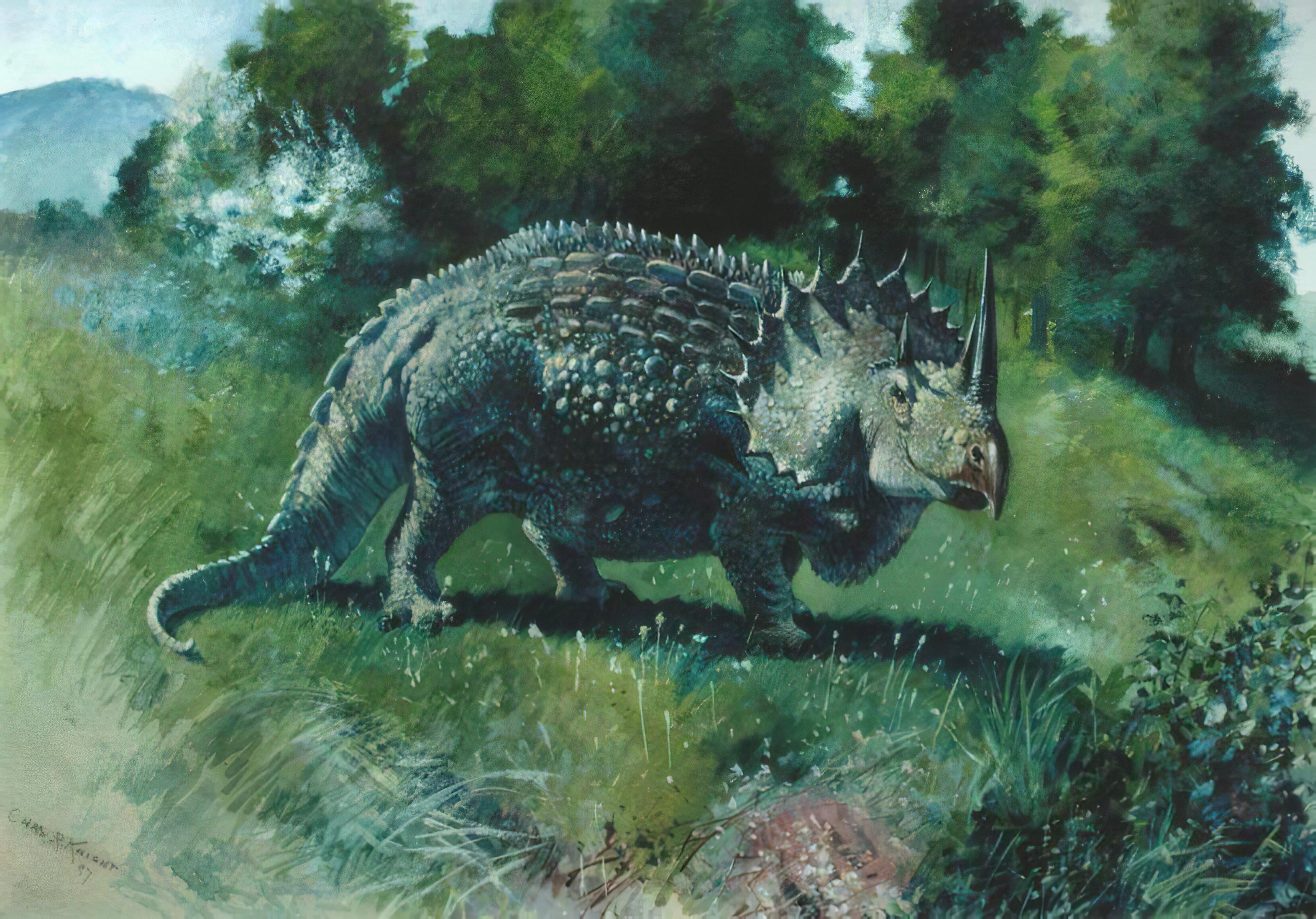
Agathaumas sphenocerus, by Charles R. Knight (1897).

Auroraceratops

A small biped from early Cretaceous China. It had the same sharp beak and grinding teeth as later ceratopsians, but only a small frill and no horns.

Numerous other small ceratopsians were quite similar. Chaoyangsaurus, Hualianceratops, Xuanhuaceratops, and Yinlong were all from late Jurassic China. Yamaceratops lived in Mongolia during the late Cretaceous.

Auroraceratops

ST 7; DX 12; IQ 3; HT 12.
HP 7; Will 10; Per 12; FP 12; Speed 6.00; Dodge 9; Move 6.
SM −1, 40 lbs.

Beak (12): 1d−4 large piercing. Reach C.
Claw (12): 1d−3 crushing. Reach C.

Traits: Bad Sight (Low Resolution); Discriminatory Smell; DR 1 (Tough Skin); Enhanced Move 1 (Ground Speed 12); Night Vision 2; No Fine Manipulators; Wild Animal.
Skills: Stealth-12; Survival (Woodlands)-12.

For Chaoyangsaurus, Hualianceratops, Xuanhuaceratops, and Yinlong (12-20 lbs.) reduce ST and HP to 5, SM to −2, and damage to 1d−5 with the beak or 1d−4 with a claw. For Yamaceratops (4 lbs.) reduce ST and HP to 3, SM to −3, change damage to 1d−6 with the beak or 1d−5 with a claw, and remove DR.

Protoceratops

Combining features of smaller ceratopsians like Auroraceratops with those of the horned giants, Protoceratops was a pig-sized animal with a modest frill and small nasal horn. It spent most of its time on all fours, but could run on two legs if needed. It lived in China and Mongolia during the late Cretaceous.

Nesting Protoceratops, by Charles R. Knight (1927).

Protoceratops shared its habitat with Udanoceratops, a larger, hornless creature with powerful jaws for tearing apart tough plants. It was related to Leptoceratops from late Cretaceous Larimidia (now Western North America), which was about the size of Protoceratops.

Protoceratops

ST 15; DX 11; IQ 3; HT 12.
HP 15; Will 10; Per 12; FP 12; Speed 5.00; Dodge 8; Move 5.
SM +1 (3 hexes), 400 lbs.

Beak (11): 1d large piercing. Reach C.
Claw (11): 1d+1 crushing. Reach C.

Traits: Bad Sight (Low Resolution); Discriminatory Smell; DR 3 (Tough Skin); Enhanced Move 1 (Ground Speed 10); Night Vision 1; No Fine Manipulators; Wild Animal.
Skills: Survival (Desert)-14.

For Udanoceratops (1,500 lbs.) raise ST and HP to 23, SM to +2 (4 hexes), DR to 4, add Striking ST 4 (Beak Only), changing damage to 2d+2 with either beak or claw, and replace Enhanced Move with Semi-Upright. Leptoceratops (400 lbs.) just adds Striking ST 2 (Beak Only), changing damage with the beak to 1d+1.

Psittacosaurus

The various species of this large genus lived all over Asia during the early Cretaceous. Their overall body plan was similar to Auroraceratops, but they had chisel-shaped teeth and short but powerful beaks, ideal for cracking nuts. Lacking chewing teeth, they relied on gizzard stones to grind their food. They lacked frills, but had spikes on their cheeks. Some of the scales on their upper tails were modified into long bristles or quills. Although their ‘hands’ lacked true opposable thumbs, they did have one digit which was offset and could be used to grasp.

Psittacosaurus

ST 7; DX 11; IQ 3; HT 12.
HP 7; Will 10; Per 12; FP 12; Speed 5.00; Dodge 8; Move 5.
SM −1, 40 lbs.

Beak (11): 1d−2 crushing. Reach C.
Claw (11): 1d−3 crushing. Reach C.

Traits: Bad Grip 1; Bad Sight (Low Resolution); Discriminatory Smell; DR 1 (Tough Skin); Enhanced Move 1 (Ground Speed 10); Ham-Fisted 2; Night Vision 2; Striking ST 2 (Beak Only); Wild Animal.
Skills: Stealth-12; Survival (Woodlands)-12.

This profile suits the larger species of Psittacosaurus, such as P. amitabha, P. major, P. mongoliensis, and P. sibiricus. For smaller ones such as P. gobiensis or P. sinensis (12-20 lbs.) reduce ST and HP to 5 and damage to 1d−3 with the beak or 1d−4 with a claw.

Triceratops

The famous three-horned monster had a huge head with a relatively small and plain frill. The neck and body were short and wide, while the tail turned sharply downward behind the pelvis. Large scales on the body had short spikes and the toes were capped with hooves. Although often portrayed as a herd animal, there is little evidence to suggest that adult triceratops gathered in groups. Juveniles seem to have stayed with their nest-mates (and possibly parents) for protection though. They lived in Larimidia during the late Cretaceous.

Tyrannosaurus and Triceratops, by Charles R. Knight (1928).

Most other large ceratopsians were distinguished only by size, horns, and frill shape. All of them lived during the late Cretaceous and all were found in Larimidia except for the single-horned Sinoceratops from China. Torosaurus had horns very like Triceratops, but a larger frill with two openings in the bone. Some scientists believe that it is the same genus as Triceratops, reflecting how the frill develops in older individuals. Chasmosaurus also had three horns, but the ones above the eyes were very small and the nasal one only moderately sized. Centrosaurus had a similar arrangement, only its nasal horn was long, and its frill had several curved spikes. Large numbers of Centrosaurus fossils found together indicate that they may have gathered in herds. This is also the case for its relative Styracosaurus, which had a single nose horn and many long spikes on its cheeks and the edge of its frill. Diaboloceratops had just the two horns above its eyes and two long spikes on its frill, as did its relative Machairoceratops. Pachyrhinosaurus had blunt slabs instead of pointed of horns and lived in cold Northern regions. Pentaceratops had five horns, with two sprouting from its cheeks.

Triceratops

ST 50; DX 9; IQ 3; HT 12.
HP 50; Will 12; Per 12; FP 12; Speed 4.00; Dodge 7; Move 4.
SM +4 (16 hexes), 16,000 lbs.

Beak (11): 5d+6 large piercing. Reach C.
Horns (11): 5d+12 impaling. Reach 1. Limited arc (front). Can parry (8).
Trample with Hooves (11): 5d+12 crushing. Against SM +2 or less. 

Traits: Bad Sight (Low Resolution); Discriminatory Smell; DR 10 (Tough Skin); Enhanced Move 1 (Ground Speed 8; Costs Fatigue, 1 FP/Second); Night Vision 1; Quadruped; Wild Animal.
Skills: Brawling-11; Intimidation-12; Survival (Woodlands)-12.

For Chasmosaurus, Diabloceratops, and Machairoceratops (4,400 lbs.) lower ST and HP to 33, SM to +2 (10 hexes), and DR to 6. Change damage to 3d+4 with the beak and 3d+8 with the horns or trampling.

For Centrosaurus (5,000 lbs.) or Styracosaurus (4,700 lbs.) lower ST and HP to 34, SM to +2 (10 hexes), and DR to 6. Add Chummy. Change damage to 3d+4 with the beak and 3d+8 with the horns or trampling.

For Sinoceratops (5,500 lbs.) lower ST and HP to 35, SM to +2 (10 hexes), and DR to 7. Change damage to 4d+2 with the beak and 4d+7 with the horns or trampling.

For Pentaceratops (6,200 lbs.) lower ST and HP to 37, SM to +3 (13 hexes), and DR to 7. Change damage to 4d+3 with the beak and 4d+8 with the horns or trampling.

For Pachyrhinoceratops (6,600 lbs.) lower ST and HP to 38, SM to +3 (13 hexes), and DR to 7. Add Temperature Tolerance 2 (Cold). Change damage to 4d+3 with the beak and 4d+8 crushing with the horn (which becomes reach C) or trampling.

For Torosaurus (22,000 lbs.) raise ST and HP to 56 and DR to 11. Change damage to 6d+7 with the beak and 6d+13 with the horns or trampling.

Note: the Reach for the horns has been limited to reflect their actual length. Using the actual rules for strikers they would have Reach C-3.

Zuniceratops

A relatively small dinosaur from Southern Larimidia during the late Cretaceous. It resembled the large ceratopsians in everything but size.

Turanoceratops lived in Mongolia around the same time.

Zuniceratops

ST 15; DX 10; IQ 3; HT 12.
HP 15; Will 10; Per 12; FP 12; Speed 5.00; Dodge 8; Move 5.
SM +1, 400 lbs.

Beak (10): 1d large piercing. Reach C.
Horns (10): 1d+2 impaling. Reach 1. Limited arc (front). Can parry (8).

Traits: Bad Sight (Low Resolution); Discriminatory Smell; DR 10 (Tough Skin); Enhanced Move 1 (Ground Speed 10; Costs Fatigue, 1 FP/Second); Night Vision 1; Quadruped; Wild Animal.
Skills: Survival (Swampland)-12.

This profile works as-is for Turanoceratops.

Allosaurus in GURPS


Allosaurus by Charles R. Knight

Anatomy

Although not as heavy as the massive tyrannosaurs, Allosaurus was big for a carnosaur. Its long legs and stiff tail made it a swift straight-line pursuit predator.

It’s head was long, narrow, tapered, and mounted on a sinuous but muscular neck. Relatively weak jaw muscles, a wide gape, and small serrated teeth suggest that it carved pieces off big prey by dragging its upper teeth through their flesh. The fore-limbs were small but still strong enough to drive their three hooked claws into a victim and hang on as it struggled. The feet, each with three clawed toes and a dewclaw, also seem to have been used to restrain prey.

Two bony crests ran along the top of the skull, with a horn-like projection before the eyes. Lizard-like lips would have sealed the mouth to prevent the teeth from being damaged by dry air. Only a few skin samples have been identified, which all show small scales. Although it is possible that some parts had proto-feathers, they would not have been necessary for insulation, so it is likely that the overall appearance would have been that of a lizard with bird-like legs.

Behavior and Habitat

The favorite prey of Allosaurs seems to have been large sauropods, which they hunted in the warm fern prairies and floodplains of the late Jurassic. They had a wide range, often living in environments which would have varied seasonally from wetland to almost desert-like conditions.

Their brains weren’t especially large and there is little evidence of social behavior, so it is likely they were solitary hunters who used a simple stalk-and-dash strategy to take slower prey.

Allosaurus fragilis

ST 34; DX 10; IQ 2; HT 11.
HP 34; Will 10; Per 11; FP 11; Speed 5.00; Dodge 8; Move 6.
SM +4 (9 hexes), 5,000 lbs.

Bite (12): 3d+4 cutting. Reach C. Effective ST 36 for grappling.
Fore-Claw (12): 1d+2 cutting. Reach C-3. Effective ST 19 for grappling.
Hind-Claw (10): 3d+5 cutting. Reach C-4. Effective ST 38 for grappling.

Traits: Born Biter 3; Discriminatory Smell; DR 2; Enhanced Move 1 (Ground Speed 12); Limited Camouflage; Reduced Consumption 1 (Water only); Weak Arms (½ ST); Wild Animal.
Skills: Brawling-12; Running-12; Stealth-12; Survival (Plains)-12; Wrestling-12.

The largest specimens of A. fragilis (10,000 lbs.) increase ST and HP to 43 (damage becomes 5d+3 with a bite, 2d+1 with a fore-claw, and 5d+4 with a hind-claw) but drop Move to 4 (reducing ground speed with Enhanced Move to 8). For A. europaeus (3,300 lbs.) and A. jimmadseni (3,500 lbs.) reduce ST and HP to 30 (damage becomes 3d+2 with a bite, 1d+1 with a fore-claw, and 3d+3 with a hind-claw).

Note: the reach for the limbs is excessive if you measure it from the front hex of the figure, since they shouldn't even be able to reach the front hex! Measure reach from the central hex for more realistic results, or just treat them all as Reach C.

Tyrannosaurus rex in GURPS

Tyrannosaurus rex ‘the king of the tyrant-lizards’ is the most iconic of all dinosaurs, the largest land predator that ever walked the Earth.

Anatomy

A heavily-built beast, with a broad snout, which flared out into even broader cheeks, a short thick neck, a stout body, relatively tiny arms, long legs, and a thick tail. The diminutive forelimbs had two claws each, while the hind feet had three which came into contact with the ground and one which didn’t. Its teeth were long, sharp, and set into a massive skull which could deliver intense bite forces. Lizard-like lips concealed the teeth, protecting them from the elements. Ridges of heavy scales covered the snout and curved back around the eyes. The skin of adults seems to have been entirely featherless and covered with small, round, non-overlapping scales. 

Movement

Although its long legs enabled long, energy-efficient strides, a fully grown tyrannosaur could not take advantage of this to achieve high speeds without risking injury. The colossal impact of each step was only somewhat managed by the thick cushioning on each foot.

Senses

Although its eyes are almost lost in the massive face, they were actually some of the largest of any animal. They seem to have been optimised for daylight and tyrannosaurs may have had vision better than birds of prey. Their hearing and sense of smell would also have been very good, with brain regions relating to them being enlarged.

Intelligence

Despite being stereotyped as crude and stupid, tyrannosaurs had relatively large brains, and would probably have been smarter than most reptiles, and possibly many birds and mammals. However, with large amounts of brain dedicated to processing sensory information and precise control over movement, it is doubtful there was much to spare for more abstract thinking.

Social Behaviour and Hunting Strategies

There is some evidence that tyrannosaurs lived in groups, although it is impossible to say how big they were or what social structures they formed. One hypothesis is that adults and young worked as a ‘combined arms’ team where the juveniles herded prey into the path of mature predators. If this wasn’t the case, they would have hunted different prey, occupying different ecological niches at different stages of development. While younger individuals could run their prey down quickly, older ones may have had to rely on ambush, or wearing down their target with lengthy pursuit. Few other large or medium sized predators seem to have been able to compete with them.

Habitat

T. rex lived across a huge area with multiple different types of terrain, from forests to semi-arid plains, but it was most common in the wetlands bordering the Western Interior Seaway (where the Great Plains are now). These would have been similar to the modern bayous of the Gulf Coast.

Tyrannosaurus rex

ST 46; DX 11; IQ 3; HT 12.
HP 46; Will 11; Per 13; FP 12; Speed 5.00; Dodge 8; Move 5.
SM +4 (20 hexes), 12,000 lbs.

Bite (13): 6d+4 impaling. Reach C. If a bite hits, can grapple with effective ST 48.
Claw, Slash (13): 1d−1 cutting. Reach C.
Claw, Grapple (11): Reach C. Effective ST 14.
Stamp (10): 5d+6 crushing. Reach C.
Tail-Swipe (13): 5d+10 crushing. Reach 3. Rear only.
Trample (13): 5d+5 crushing. Against SM +2 (+3 if prone) or less.

Traits: Acute Vision 2; Born Biter 2; Discriminatory Smell; DR 3 (Tough Skin); DR 3 (Face Only); Ham-Fisted 2; Limited Camouflage; 2 Short Arms; Silence 1; Striker (Tail; Cannot Parry; Limited Arc, Rear); Striking ST 5 (Bite only); Subsonic Hearing; Weak Arms (¼ ST); Wild Animal.
Skills: Brawling-13; Hiking-16; Intimidation-12; Stealth-12; Survival (Swampland)-13; Swimming-14; Tracking-17; Wrestling-13.

This profile represents a typical adult T. rex. The very largest (18,000 lbs.) get ST and HP 52, giving effective ST 54 with a biting grapple and 15 with a claw grapple. Damage increases to 6d+7 with a bite, 1d with a claw, 6d+6 with a stamp, 6d+12 with the tail, and 6d+5 when trampling. For a small adult or nearly-mature sub-adult (7,000 lbs.) reduce ST and HP to 38, SM to +3 (16 hexes), DR (both) to 2, and Striking ST to 3. This changes effective ST to 40 with a bite grapple, 12 with a claw grapple. Tail reach becomes 2 and maximum SM for trampling victims becomes +1. Damage changes to 4d+5 with a bite, 1d−2 with a claw, 4d+5 with a stamp, 4d+8 with the tail, and 4d+4 when trampling.

Juveniles

Young tyrannosaurs looked quite different to the adults. They were small, lightly-built, very long-legged, and probably covered in fluffy proto-feathers for insulation. Smaller body mass allowed them to run faster than their parents.

ST 25; DX 11; IQ 2; HT 12.
HP 25; Will 10; Per 12; FP 12; Speed 5.00; Dodge 8; Move 5.
SM +2 (9 hexes), 2,000 lbs.

Bite (12): 2d+1 cutting. Reach C. If a bite hits, can grapple with effective ST 26.
Claw, Slash (12): 1d−5 cutting. Reach C.
Claw, Grapple (10): Reach C. Effective ST 7.
Kick (10): 2d+2 cutting. Reach C-2.
Tail-Swipe (12): 2d+4 crushing. Reach 2. Rear only.

Traits: Acute Vision 1; Born Biter 2; Discriminatory Smell; DR 1 (Tough Skin); DR 1 (Face Only); Enhanced Move 1 (Ground Speed 10); Ham-Fisted 2; Limited Camouflage; 2 Short Arms; Silence 1; Striker (Tail; Cannot Parry; Limited Arc, Rear); Subsonic Hearing; Weak Arms (¼ ST); Wild Animal.
Skills: Brawling-12; Stealth-12; Survival (Swampland)-12; Swimming-13; Tracking-15; Wrestling-12.

For an even younger juvenile (200 lbs.) reduce ST and HP to 12. This changes damage to 1d−2 with a bite, 1d−6 with a claw, 1d−1 with a kick, and 1d with a tail-swipe.

Alternative Takes

Early interpretations of T. rex were essentially similar to the current scientific consensus: it was a slow-moving predator with many lizard-like features, about 40 feet long and weighing around six tons. The main differences were that it was often portrayed in a somewhat upright tail-dragging posture, and that it was believed, like most dinosaurs, to be profoundly stupid. Reduce adult IQ to 2 and remove Enhanced Move on the juvenile to represent such creatures.


Tyrannosaurus rex, by Charles R. Knight (1940)

Some have suggested that tyrannosaurs were more scavengers than hunters. Large terrestrial scavengers are rather rare, and it seems unlikely that a warm-blooded animal of such size would be able to find enough carrion to sustain it. However, if you want to create a giant land vulture, add Reduced Consumption (Cast-Iron Stomach) or Resistant to Disease, remove the Stealth skill, and increase Survival. Either hunting or scavenging could have been combined with kleptoparasitism, stealing the kills of smaller predators. Given their dominance of all ecological roles for large predators, this could mean mostly stealing from their own species! Improve Intimidation if this is a major source of food.

A more recent trend was to assume that they could sprint quite fast. The latest computer modelling suggests that the leg bones of a full-sized adult would crack under the strain of moving more than about 11 miles per hour. Add up to 2 levels of Enhanced Move to the adult if you wish to ignore that.

Many skeletons which are generally accepted as belonging to T. rex have been classed as different species at some point. Any of the alternative profiles could be used for one of these species. For example, a fully grown T. imperator would use the largest adult profile.

The Limited Camouflage perk reflects the fact that pack hunting or ambush require significant stealth, so some form of camouflage seems likely. Scavengers and long-distance pursuit predators may not need concealment, and so adult tyrannosaurs who use such tactics may lack effective camouflage.

Aesthetic details like whether they had lips (and, if so, how large) and the possible presence of some proto-feathers on adults make no difference in the rules but has long been the subject of passionate debate.