Showing posts with label canids. Show all posts

Dire Wolves in GURPS

This American genus was larger than modern wolves, but smaller than the cave wolves of Europe. They had slender limbs and strong jaws, and were well suited for taking down big, slow prey, or scavenging. They weren't especially close relatives to true wolves, and would not have been able to interbreed. Genetically-modified gray wolves which were edited to have some gene sequences from dire wolves have white coats, but this may not reflect the actual appearance of the extinct genus.


Dire Wolf by Charles R. Knight (1921)

Aenocyon dirus

ST 11; DX 10; IQ 4; HT 12.
HP 11; Will 12; Per 11; FP 12; Speed 6.00; Dodge 9; Move 6.
SM 0, 150 lbs.

Bite (13): 1d−1 cutting.

Traits: Bad Sight (Low Resolution); Born Biter 2; Chummy; Discriminatory Smell; DR 1 (Flexible); Enhanced Move 1.5 (Ground Speed 18; Costs Fatigue, 1 FP/second); Limited Camouflage; Night Vision 2; Parabolic Hearing 2; Quadruped; Striking ST 2 (Bite Only); Temperature Tolerance 10 (Cold); Ultrahearing; Wild Animal.
Skills: Brawling-12; Survival (Plains)-13; Tracking-15.
Cave Wolves in GURPS

Cave wolves were a (or a number of) subspecies of gray wolf which lived in Pleistocene Europe. In accordance with Carl Bergmann's famous observation that cold climates produce larger animals, they were considerably larger than modern wolves. They also had proportionally shorter legs and more powerful jaws to handle larger prey.

Canis lupus spelaeus

ST 12; DX 11; IQ 4; HT 12.
HP 12; Will 12; Per 12; FP 12; Speed 6.00; Dodge 9; Move 6.
SM 0, 200 lbs.

Bite (13): 1d−1 cutting.

Traits: Bad Sight (Low Resolution); Born Biter 2; Chummy; Discriminatory Smell; Enhanced Move 1.5 (Ground Speed 18); Night Vision 2; Parabolic Hearing 2; Quadruped; Striking ST 1 (Bite Only); Temperature Tolerance (Cold) 10; Ultrahearing; Wild Animal.
Skills: Brawling-13; Survival (Plains)-13; Tracking-16.

Borophaginae in GURPS

The ‘bone crushing dogs’ were a subfamily of canids, related to modern canines such as jackals and wolves. They thrived in North America during the Oligocene and Pliocene. They are believed to have been ambush predators who used a stalk-pounce-dash strategy similar to big cats. When cats crossed from Asia to the Americas, it seems that the borophaginae struggled to compete in the same ecological niche.

They looked somewhat like wild dogs or wolves, but with heavy builds and short jaws. Their teeth were hyena-like, well suited to (as their name suggests) crushing bones.


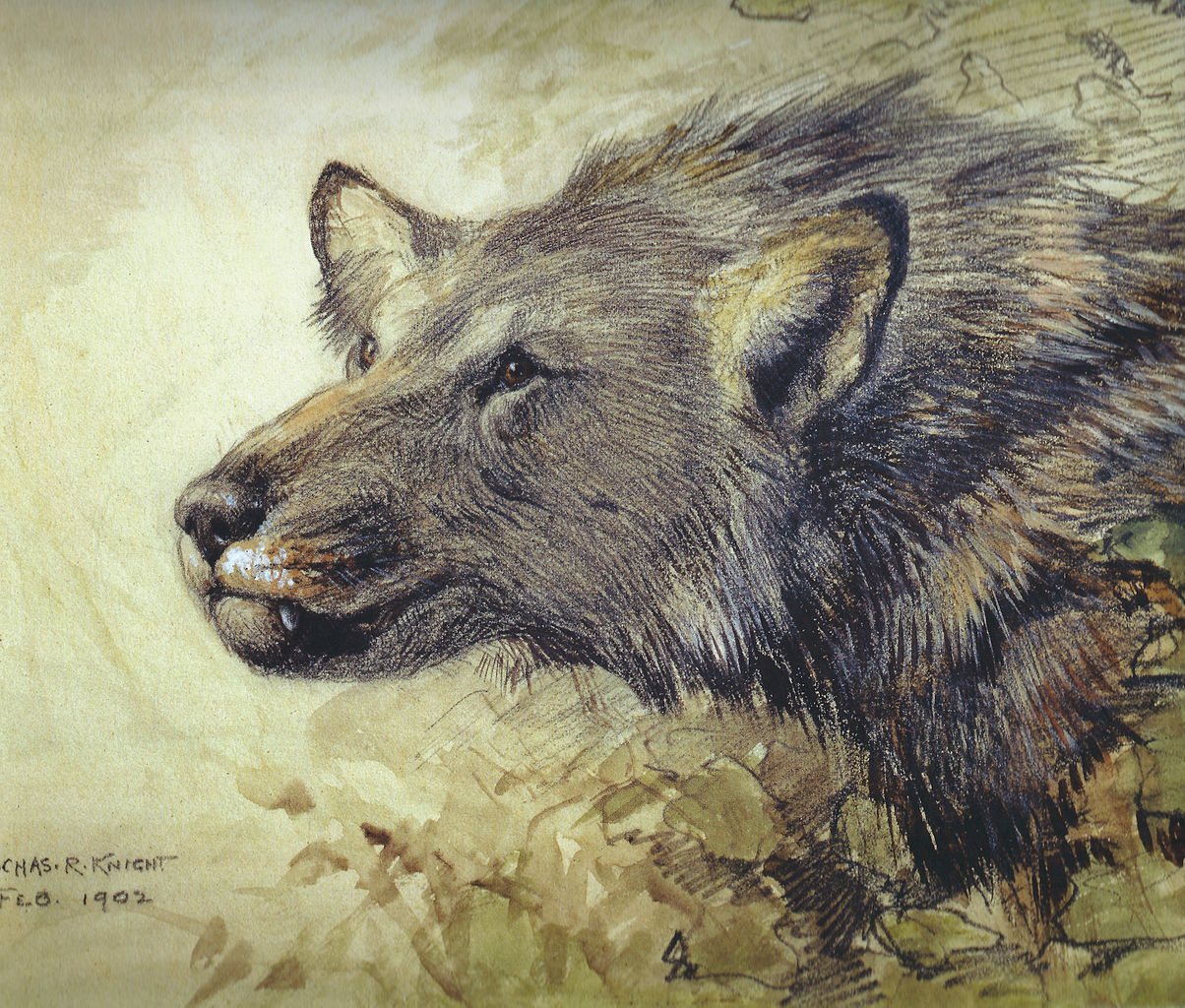
Borophagus, by Charles R. Knight (1902)

Borophagus

Although small compared to some of its relatives, the ‘gluttonous eater’ was an extremely successful genus. They seem to have been pack hunters.

Borophagus

ST 7; DX 10; IQ 4; HT 11.
HP 7; Will 12; Per 11; FP 11; Speed 5.00; Dodge 9; Move 6.
SM −1, 50 lbs.

Bite (12): 1d−2 cutting.

Traits: Born Biter 2; Chummy; Combat Reflexes; Discriminatory Smell; Enhanced Move 2 (Ground Speed 24; Costs Fatigue, 1 FP/second); Limited Camouflage; Night Vision 1; Parabolic Hearing 2; Quadruped; Reduced Consumption 1 (Cast-Iron Stomach); Striking ST 2 (Bite Only); Temperature Tolerance 3 (Cold); Wild Animal.
Skills: Brawling-12; Intimidation-12; Running-12; Stealth-12; Survival (Plains)-12; Tracking-15.

Epicyon

Epicyon lived up to its name (meaning ‘more than a dog’), being the largest of its subfamily and much bigger than any canine. They are believed to have been opportunistic predators and scavengers.

Epicyon haydeni

ST 13; DX 10; IQ 4; HT 11.
HP 13; Will 12; Per 11; FP 11; Speed 5.00; Dodge 9; Move 6.
SM +1 (2 hexes), 250 lbs.

Bite (12): 1d+2 cutting.

Traits: Acute Smell 1; Born Biter 1; Combat Reflexes; Discriminatory Smell; DR 1; Enhanced Move 1.5 (Ground Speed 18; Costs Fatigue, 1 FP/second); Night Vision 1; Parabolic Hearing 2; Quadruped; Reduced Consumption 1 (Cast-Iron Stomach); Striking ST 4 (Bite Only); Temperature Tolerance 4 (Cold); Wild Animal.
Skills: Brawling-12; Intimidation-14; Running-12; Stealth-12; Survival (Woodland)-12; Tracking-16.

Larger specimens (up to 380 lbs.) would have ST and HP 14. Smaller species such as E. saevus (110-130 lbs.) would have ST and HP 10, SM 0, Striking ST 3 and do 1d damage with their bite.